Đề ôn thi THPT Quốc Gia năm học 2017-2018 môn Tiếng Anh - Trường THPT Nguyễn Trường Tộ (Có đáp án)
 18 Trang
49
18 Trang
49
Bạn đang xem tài liệu "Đề ôn thi THPT Quốc Gia năm học 2017-2018 môn Tiếng Anh - Trường THPT Nguyễn Trường Tộ (Có đáp án)", để tải tài liệu gốc về máy hãy click vào nút Download ở trên.
Tóm tắt nội dung tài liệu: Đề ôn thi THPT Quốc Gia năm học 2017-2018 môn Tiếng Anh - Trường THPT Nguyễn Trường Tộ (Có đáp án)
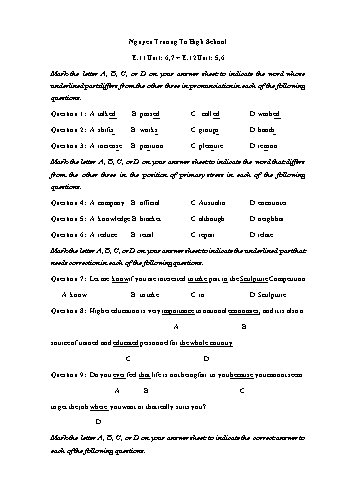
 Nguyen Truong To High School
 E.11 Unit: 6,7 + E.12 Unit: 5,6
Mark the letter A, B, C, or D on your answer sheet to indicate the word whose
underlined part differs from the other three in pronunciation in each of the following
questions.
Question 1: A. talked B. passed C. called D. washed
Question 2: A. shifts B. works C. groups D. hands
Question 3: A. increase B. position C. pleasure D. reason
Mark the letter A, B, C, or D on your answer sheet to indicate the word that differs
from the other three in the position of primary stress in each of the following
questions.
Question 4: A. company B. official C. Australia D. encounter
Question 5: A. knowledge B. bracket C. although D. neighbor
Question 6: A. reduce B. retail C. repair D. relate
Mark the letter A, B, C, or D on your answer sheet to indicate the underlined part that
needs correction in each of the following questions.
Question 7: Let me know if you are interested to take part in the Sculpture Competition.
 A. know B. to take C. in D. Sculpture
Question 8: Higher education is very importance to national economies, and it is also a
 A B
source of trained and educated personnel for the whole country.
 C D
Question 9: Do you ever feel that life is not being fair to you because you cannot seem
 A B C
to get the job where you want or that really suits you?
 D
Mark the letter A, B, C, or D on your answer sheet to indicate the correct answer to
each of the following questions. Question 10: He was the only ______that was offered the job.
 A. apply B. application C. applicant D. applying
Question 11: If I ______10 years younger, I ______the job.
 A. am/ will take C. was/ have taken
 B. had been/ will have taken D. were/ would take
Question 12: It is a course ______ two years for those who want to work as a
marketing agent.
 A. of B. in C. for D. with
Question 13: It was the worst winter______ anyone could remember.
 A. when B. which C. where D. why
Question 14: A letter of ______ is sometimes really necessary for you in a job
interview.
 A. recommend B. recommended
 C. recommender D. recommendation
Question 15: The winner of the contest was given a(n) ______ for her excellent
performance.
 A. bonus B. reward C. award D. fine
Question 16: a ______ is an official document that you receive when you have
completed a course of study or training.
 A. certificate B. vocation C. subject D. grade
Question 17: Either you or I ______ going to meet Professor Pike at the airport.
 A. were B. are C. has been D. am
Question 18: In most ______developed countries, up to 50% of ______ population
enters higher education at some time in their lives.
 A. the / a B. Ø / Ø C. Ø / the D. the / Ø
Question 19: An ______ is a student at a university or college who is studying for his
or her first degree.
 A. undergraduate B. application C. insurance D. exam
Question 20: Last week, we ______ an interesting film about the animal world. A. will see B. see C. are seeing D. saw
Mark the letter A, B, C, or D on your answer sheet to indicate the word(s) CLOSEST in
meaning to the underlined word(s) in each of the following questions.
Question 21: They quickly read the questions and tried to find out the answers.
 A. complete B. offer C. discover D. guess
Question 22: About 29% of the world’s population was living in urban areas in 1950,
this figure was 43% in 1990.
 A. regions B. locations C. borders D. destinations
Question 23: The candidate was very disappointed because he had failed the
examination.
 A. sad B. bored C. miserable D. hopeless
Mark the letter A, B, C, or D on your answer sheet to indicate the word(s) OPPOSITE in
meaning to the underlined word(s) in each of the following questions.
Question 24: If you are at a loose end tomorrow, why don’t we spend the day
sunbathing and relaxing on the beach?
 A. having a lot to do B. having nothing to do
 C. having a lot to gain D. having noting to lose
Question 25: Our traditions are very ancient and our people are very proud of them.
 A. old B. young C. modern D. real
Question 26: He had never experienced such rudeness toward the president as it
occurred at the annual meeting in May.
 A. impoliteness B. encouragement
 C. measurement D. politeness
Mark the letter A, B, C, or D on your answer sheet to indicate the most suitable
response to complete each of the following exchanges.
Question 27: -"Do you think you’ll get the job? – “_______________”
 A. Yes, that’s right B. I think not C. Well, I hope so D. I know so
Question 28: - “_________________” – “I have got a terrible headache.”
 A. What’s the matter with you B. What’s the wrong with you C. What’s happened with you D. What’s problem with you
Question 29: - “Our team has just won the last football match” – “_____________”
 A. Good idea. Thanks for the news. B. Yes, I guess it’s very good.
 C. Well, that’s very surprising D. Yes, it’s our pleasure.
Read the following passage and mark the letter A, B, C, or D on your answer sheet to
indicate the correct word or phrase that best fits each of the numbered blanks.
 Mexico City is growing quickly. In 1970, the city had about 9 million people. Now
it has over 17 million. All these people are causing (30) ______for the city. There are
not enough jobs. Also, there is' not enough housing. Large families have to live together
in small homes. Many homes do not have water. They also do not have bathrooms or
electricity. The Mexican government is (31) ______ about all these problems. It is
working hard to make (32) ______ better in the city.
 Why is Mexico City growing so (33) ______? Where are all these people coming
from? They are coming to the city from the country. Life is hard on the farms in
Mexico. Most people on farms have to live a very simple life. They have no (34)
______ money for modern things. People think life in the city must be (35) ______. So
they leave their farms and move to Mexico City.
 All around the world, large cities have the same problems. One of them is air (36)
______. Mexico City has pad air. It is dirty and unhealthy. Cars are one reason for the
dirty air. Many Mexicans now own their own cars and drive in the city. The factories in
the area also cause air pollution. These factories put a lot of (37) ______ into the air. It
is not easy to clean up the air in a large city. The government has to make new laws, and
everyone has to help.
Question 30: A. problems B. matters C. things D. news
Question 31: A. worried B. interested C. discussed D. known
Question 32: A. duration B. circle C. live D. life
Question 33: A. normal B. fast C. slow D. average
Question 34: A. bonus B. extra C. added D. given
Question 35: A. bad B. good C. better D. best
Question 36: A. pollution B. matter C. complaint D. comment
Question 37: A. dirt B. smoke C. noise D. pollution Read the following passage and mark the letter A, B, C, or D on your answer sheet to
indicate the correct answer to each of the questions.
 THE OLYMPIC GAMES
 During the Olympic games, people from all over the world come together
in peace and friendship. Some of these people compete for medals. Several million
people attend the games, and millions of other people watch them on television.
 Why do we have the Olympic games? How did they begin? The first Olympic
Games that we have records of were in Greece in 776 B.C. The games lasted one day.
The only event in the first thirteen Olympic Games was a race. Men ran the length of
the stadium (about 192 meters). Then, longer running races were added. Through the
years, a few other kinds of events, like the long jump, were also added. During this
time, the games were for men only, and women could not even watch them. In the year
393, a Roman emperor ended the Olympic Games because the quality of the games
became very low. The Olympics did not take place again for 1500 years!
 In 1894, Pierre de Courbertin of France helped form the International Olympic
Committee, and the modern Olympic Games began. In 1896 the games were held again
in Athens, Greece. The Greeks built a new stadium for the competition. Three hundred
and eleven athletes from thirteen countries competed in many events. The winners
became national heroes.
 After 1896, the games were held every four years during the summer in different
cities around the world. In 1900, the Olympics were in Paris, France, and women
competed for the first time. In 1908, in London, England, the first gold medals were
given to winning athletes. Before that time, the winners received only silver and bronze
medals.
 The Olympic flag was first introduced in 1920 in Antwerp, Belgium. The flag has
five rings on it. The rings represent the continents of Africa, Asia, Australia, Europe,
and North and South America. Each ring is a different colorblue, yellow, black, green,
or red - because the flag of each of the countries that compete in the games has at least
one of these colors in it.
 The Olympic Winter Games began in 1924 in Chamois, France. Athletes
competed in winter events such as skiing, ice skating, and ice hockey. Today, the
Winter Games take place every four years. The Summer Games also take place every four years, but not. in the same year as the winter events. Both the Summer Games and
the Winter Games must have at least fifteen events, and they cannot last more than
sixteen days.
 Until recently, Olympic competitors could not be professional athletes. All of the
athletes in the Olympic Games were amateurs. Today, however, many of the Olympic
athletes are professionals who play their sports for money during the year. Some people
disagree with this idea. They believe that the Olympic Games are for amateur athletes,
not paid professionals. Other people think that anyone can play in the Olympic Games.
No matter who the athletes are, millions of people throughout the world enjoy watching
the greatest athletic competitions, the Summer games and the Winter Games of the
Olympics.
Question 38: Which of the following is not true of the first 13 Olympic Games in
Greece?
 A. They lasted only one day.
 B. The men competed while the women watched.
 C. They consisted of only one event, which was race running.
 D. They were for men only.
Question 39: Pierre de Coubertin ______.
 A. was the first athlete from France to take part in the modern Olympic Games
 B. helped the Greeks build a new stadium for the modern Games.
 C. helped to revive the Games.
 D. became a national hero of France.
Question 40: The International Olympic Committee was set up ______.
 A. with Pierre de Coubertin as chairman
 B. according the wish of a Roman emperor
 C. every four years starting from 1894
 D. two years before the modern Olympic Games were held
Question 41: Women first competed in the Games ______.
 A. in 1908 in London, England
 B. in the Paris Olympics of 1900 C. as soon as the Olympic Games were resumed
 D. in 1896 at Pierre de Coubertin's suggestion
Question 42: What was special about the 1920 Olympics?
 A. The Olympic flag was introduced.
 B. Gold medals were given to winning athletes for the first time.
 C. Women were allowed to compete for the first time.
 D. The Ofympic Winter Games were held.
Question 43: Which of the following is not true?
 A. There is an interval between the Summer and the Winter Games.
 B. The games can't last longer than 16 days.
 C. The Summer Games have more sporting events than the Winter Games.
 D. The Olympic flag has five rings of five different colors on it.
Question 44: Professional athletes ______.
 A. joined the Olympic Games only recently.
 B. have been allowed to compete in the Games since the Olympic flag was
introduced
 C. get paid for taking part in the Olympic Games
 D. have won more gold medals than amateurs have
Mark the letter A, B, C or D on your answer sheet to indicate the sentence that is
closest in meaning to each of the following questions.
Question 45: If I were taller, I could reach the top shelf.
 A. I am not tall enough to reach the top shelf.
 B. I am too tall to reach the top shelf.
 C. I cannot reach the top shelf because I am very tall.
 D. In spite of being tall, I cannot reach the tip shelf.
Question 46: John, whose cough is terrible, needs to see a doctor.
 A. John’s terrible cough prevents from seeing a doctor.
 B. John needs to see a doctor because of his terrible cough. C. John’s doctor does not want to see him because he has a bad cough.
 D. John’s terrible cough forces him to see a doctor.
Question 47: The last time when I saw her was three years ago.
 A. I have often seen her for the last three years.
 B. About three years ago, I used to meet her.
 C. I have not seen her for three years.
 D. I saw her three years ago and will never meet her again.
Mark the letter A, B, C or D on your answer sheet to indicate the sentence that best
combines each pair of sentences in the following questions.
Question 48: Minh had all the necessary qualifications. They didn’t offer him the job.
 A. They didn’t offer Minh the job as he had all the necessary qualifications.
 B. Despite having all the necessary qualifications, Minh was not offered the job.
 C. If Minh had had all the necessary qualifications, he would have been offered the
job.
 D. Minh had all the necessary qualifications, so they didn’t offer him the job.
Question 49: The agreement ended six-month negotiation. It was signed yesterday.
 A. The agreement which ends six-month negotiation was signed yesterday.
 B. The agreement which was signed yesterday lasted six months.
 C. The negotiation which lasted six months was signed yesterday.
 D. The agreement which was signed yesterday ended six-month negotiation.
Question 50: You don’t try to work hard. You will fail in the exam.
 A. Unless you don’t try to work hard, you will fail in the exam.
 B. Unless you try to work hard, you won’t fail in the exam.
 C. Unless you try to work hard, you will fail in the exam.
 D. Unless do you try to work hard, you will fail in the exam.
 -----THE END---- KEYS
Câu Đáp án Câu Đáp án
 1 C 26 D
 2 D 27 C
 3 A 28 A
 4 A 29 C
 5 C 30 A
 6 B 31 A
 7 B 32 D
 8 A 33 B
 9 D 34 B
 10 C 35 C
 11 D 36 A
 12 A 37 B
 13 B 38 B
 14 D 39 C
 15 C 40 D
 16 A 41 B
 17 D 42 A
 18 C 43 C
 19 A 44 A
 20 D 45 A
 21 C 46 B
 22 A 47 C
 23 D 48 B
 24 A 49 D 25 C 50 C
 E.11 Unit: 8,9 + E.12 Unit: 8,10
Mark the letter A, B, C, or D on your answer sheet to indicate the word that differs
from the other three in the position of primary stress in each of the following
questions.
Question 1. A. celebrate B. decorate C. entertain D. influence
Question 2. A. technology B. competitive C. facsimile D. document
Mark the letter A, B, C, or D on your answer sheet to indicate the word whose
underlined part differs from the other three in pronunciation in each of the following
questions.
Question 3. A. thrive B. threathen C. through D. these
Question 4. A. played B. shared C. loved D. decided
Mark the letter A, B, C, or D on your answer sheet to indicate the most suitable
response to complete each of the following exchanges.
Question 5. Do you mind if I borrow a chair? - ______. Do you only need one?
 A. I’m sorry B. Yes, I do C. Yes, I would D. Not at all
Question 6. Hung: “Thank you very much for a lovely party”
 Hoa: “______”
 A. You are welcome B. Thanks
 C. Cheers D. Have a good day
Mark the letter A, B, C, or D on your answer sheet to indicate the word(s) OPPOSITE
in meaning to the underlined word(s) in each of the following questions.
Question 7. The hotel staff are always friendly and courteous.
 A. efficient B. impolite C. helpful D. perfect
Question 8. Optimists are people who always expect good things to happen.
 A. Pessimists B. Biologists C. Scientists D. Terrorists Mark the letter A, B, C, or D on your answer sheet to indicate the word(s) CLOSEST
in meaning to the underlined word(s) in each of the following questions.
Question 9. The whole family usually tries to get together at Christmas.
 A. contact B. gather C. relate D. communicate
Question 10. In the future, many large corporations will be wiped out.
 A. companies B. services C. supermarkets D. farms
Mark the letter A, B, C, or D on your answer sheet to indicate the correct answer to
each of the following questions.
Question 11. In Britain and America, it is ______for everybody to sing 'Auld Lang
Syne' on New Year's Eve.
 A. tradition B. traditional C. traditionally D. traditionalism
Question 12. The wetland is ______ to a large variety of wildlife
 A. land B. accommodation C. house D. home
Question 13. His car struck ______ tree; you can still see the mark on ______ tree.
 A. a/a B. the/ the C. a/the D. the/a
Question 14. The more powerful weapons are, the more terrible the ______ is.
 A. creativity B. history C. terrorism D. technology
Question 15. ______ waiting to hear the results.
 A. Everyone was B. All was C. Everyone were D. All were
Question 16. She lives in the house ______.
 A. which has the red door B. has the red door
 C. that with the red door D. with its red door
Question 17. People believed that what they do on the first day of the year will ______
their luck during the whole year.
 A. control B. influence C. exchange D. result
Question 18. On the first -day of Tet, children ______ their new clothes and make New
Year's wishes to their parents.
 A. take on B. pick on C. put on D. try on Question 19. John is not at home. He ______ go somewhere with Daisy. I am not sure.
 A. might B. will C. must D. should
Question 20. The problem ______ never occurred.
 A. I hadn't expected it B. that I had expected it
 C. who I had expected D. I had expected
Question 21. You ______ touch that switch, whatever you do.
 A. mustn’t B. needn’t C. won’t D. wouldn’t
Question 22. Why are you so rude ______ your sisters? Can’t you be nice ______
them?
 A. with/with B. at/ to C. to/to D. on/ with
Read the following passage and mark the letter A, B, C, or D on your answer sheet to
indicate the correct word or phrase that best fits each of the numbered blanks from 23
to 27.
 A major revolution for the automated office is electronic mail. The customary postal
system requires message written on paper to be (23) ______ physically from one
location to another. With electronic mail, messages are converted into electronic signals,
tranmitted (24) ______ in the world, and then changed back into the original written
form, all in several seconds and minutes at most.
 Through the use of video screens in company offices, a single document can be
transmitted to hundreds of people in dozens of branch offices at the same time. Thus,
electronic mail, along with (25) ______, can be an important asset in teleconferences.
Furthermore, the use of electric mail in the form of a 'mailbox' (26) ______ to a
telephone is also of great value. Since in offices many telephone (27) ______ go
uncompleted on the first attempt, with electronic mail, two-way conversion is not
essential, so it reduces telephone use and saves time.
Question 23. A. transacted B. transferred C. transformed D. transmitted
Question 24. A. wherever B. anywhere C. somewhere D. everywhere
Question 25. A. programs B. graphics C. websites D. databases
Question 26. A. attached B. transmitted C. extended D. spread
Question 27. A. bills B. calls C. uses D. services Read the following passage and mark the letter A, B, C, or D on your answer sheet to
indicate the correct answer to each of the questions from 28 to 34.
 Different cultures follow their own special customs when a child's baby teeth fall
out. In Korea, for example, they have the custom of throwing lost teeth up on the roof of
a house. According to tradition, a magpie will come and take the tooth. Later, the
magpie will return with a new tooth for the child. In other Asian countries, such as
Japan and Vietnam, children follow a similar tradition of throwing their lost teeth onto
the roofs of houses.
 Birds aren't the only animals thought to take lost teeth. In Mexico and Spain,
tradition says a mouse takes a lost tooth and leaves some money. However, in
Mongolia, dogs are responsible for taking teeth away. Dogs are highly respected in
Mongolian culture and are considered guardian angels of the people. Tradition says that
the new tooth will grow good and strong if the baby tooth is fed to a guardian angel.
Accordingly, parents in Mongolia will put their child's lost tooth in a piece of meat and
feed it to a dog.
 The idea of giving lost teeth to an angel or fairy is also a tradition in the West. Many
children in Western countries count on the Tooth Fairy to leave money or presents in
exchange for a tooth. The exact origins of the Tooth Fairy are a mystery, although the
story probably began in England or Ireland centuries ago. According to tradition, a child
puts a lost tooth under his or her pillow before going to bed. In the wee hours, while the
child is sleeping, the Tooth Fairy takes the tooth and leaves something else under the
pillow. In France, the Tooth Fairy leaves a small gift. In the United States, however, the
Tooth Fairy usually leaves money. These days, the rate is $1 to $5 per tooth, adding up
to a lot of money from the Tooth Fairy!
 (Source: Reading Challenge 2 by Casey Malarcher & Andrea Janzen)
Question 28. What is the passage mainly about?
 A. Traditions concerning children's lost teeth
 B. Presents for young children's lost teeth
 C. Animals eating children's lost teeth
 D. Customs concerning children's new teeth
Question 29. The word "their" in paragraph 1 refers to ______. A. houses' B. roofs' C. children's D. countries'
Question 30. According to the passage, where is a child's lost tooth thought to be taken
away by a mouse?
 A. In Mexico and Spain B. In Mongolia
 C. In Japan and Vietnam D. In Korea
Question 31. According to paragraph 2, parents in Mongolia feed their child's lost tooth
to a dog because ______.
 A. they know that dogs are very responsible animals
 B. they believe that this will make their child's new tooth good and strong
 C. they think dogs like eating children's teeth
 D. they hope that their child will get some gifts for his or her tooth
Question 32. The word "origins" in paragraph 3 is closest in meaning to ______.
 A. countries B. families C. beginnings D. stories
Question 33. According to the passage, which of the following is NOT true about the
tradition of tooth giving in the West?
 A. Children give money to the Tooth Fairy.
 B. Children put their lost teeth under their pillows.
 C. Children hope to get money or gifts from the Tooth Fairy.
 D. Lost teeth are traditionally given to an angel or fairy.
Question 34. The phrase "the wee hours" in paragraph 3 probably refers to the period
of time ______.
 A. early in the evening B. soon after midnight
 C. late in the morning D. long before bedtime
Read the following passage and mark the letter A, B, C, or D on your answer sheet to
indicate the correct answer to each of the questions from 35 to 42.
 The last two decades have seen enormous changes in the way people's lives are
affected by IT. Twenty years ago, few people had access to a computer whilst today
most people use them at work, home or school and use of e-mail and the Internet is an
every day event. These developments have brought many benefits to our lives. E-mail makes
communication much easier and more immediate. This has numerous benefits for
business, commerce, and education. The World Wide Web means that information on
every conceivable subject is now available to us. Clearly, for many people this has made
life much easier and more convenient.
 However, not all the effects of the new technology have been beneficial. Many
people feel that the widespread use of e-mail is destroying traditional forms of
communication such as letter writing, telephone and face-to-face conversation. In
addition, the huge size of the Web means it is almost impossible to control and regulate.
This has led to many concerns regarding children accessing unsuitable websites. In
conclusion, developments in IT have brought many benefits, yet I believe developments
relating to new technology in the future are likely to produce many negative effects that
will need to be addressed very carefully.
Question 35. In the last twenty years
 A. there have been dramatic changes in the field of computer science
 B. people's lives have been changed a lot because of the invention of the computer.
 C. the World Wide Web and e-mail communication have affected modern life.
 D. there have been developments in telecomunications.
Question 36. According to the passage, E-mail
 A. reduces face-to-face contact B. can be checked quickly and easily
 C. is used only in business D. takes a lot of time to transmit
Question 37. What makes communication much easier and more immediate?
 A. E-mail B. TV C. bike D. Radio
Question 38. The World Wide Web and e-mail communication
 A. causes a busy and exciting life
 B. have also been used for education purpose
 C. is difficult to get access to
 D. is destroying traditional customs
Question 39. What does the IT stand for?
 A. Information Transfer B. Information Transmission C. Information Theory D. Information Technology
Question 40. Which sentence is NOT mentioned?
 A. The World Wide Web is difficult to navigate.
 B. The World Wide Web provides information.
 C. The World Wide Web is difficult to control.
 D. E-mail communication is quick and easy.
Question 41. What is use of e-mail destroying?
 A. Traditional forms of communication such as letter writing, telephone and face-to-
 face conversation.
 B. Traditional forms of communication such as letter writing.
 C. Telephone and face-to-face conversation.
 D. Non-verbal forms of communication.
Question 42. The writer thinks future IT developments will be
 A. more positive B. more negative C. more rapid D. unexpected
 Mark the letter A, B, C, or D on your answer sheet to indicate the sentence that is
closest in meaning to each of the following questions.
Question 43. Perhaps the others are looking for us now.
 A. The others must be looking for us now.
 B. The others might be looking for us now.
 C. The others should be looking for us now.
 D. The others have to be looking for us now.
Question 44. The best decision would have been for you to accept the offer.
 A. You ought to have accepted the offer. B. You must have accepted the offer.
 C. You need have accepted the offer. D. You could have accepted the offer.
Question 45. It’s obvious that the child has run away.
 A. The child must have run away. B. The child might have run away.
 C. The child need have run away. D. The child could have run away. Mark the letter A, B, C, or D on your answer sheet to indicate the underlined part that
needs correction in each of the following questions.
Question 46. You mustn’t wear your best clothes. You can wear whatever you like.
 A B C D
Question 47. Mark doesn’t needs to finish his report today. He can do it at the weekend.
 A B C D
Question 48. It is complicated because pollution is caused by things when benefit
people. A B C D
Mark the letter A, B, C, or D on your answer sheet to indicate the sentence that best
combines each pair of sentences in the following questions.
Question 49. He gave the information. I wrote it down at once.
 A. He gave me the information that I wrote it down at once.
 B. He gave me the information, that I wrote down at once.
 C. He gave me the information which I wrote it down at once.
 D. He gave me the information which I wrote down at once.
Question 50. They booked the hotel. They had stayed there on their honeymoon.
 A. They booked the hotel where they had stayed on their honeymoon.
 B. They booked the hotel where they had stayed there on their honeymoon.
 C. They booked the hotel which they had stayed on their honeymoon.
 D. They booked the hotel which they had stayed there on their honeymoon.
-----THE END----
KEYS
Câu Đáp án Câu Đáp án
1 C 26 A
2 D 27 B
3 D 28 A 4 D 29 C
5 D 30 A
6 A 31 D
7 B 32 C
8 A 33 A
9 B 34 A
10 A 35 C
11 B 36 A
12 B 37 A
13 C 38 B
14 C 39 D
15 A 40 A
16 A 41 A
17 B 42 B
18 C 43 B
19 A 44 A
20 D 45 A
21 A 46 A
22 C 47 A
23 D 48 D
24 B 49 D
25 D 50 A
File đính kèm:
- de_on_thi_thpt_quoc_gia_mon_tieng_anh_truong_thpt_nguyen_tru.doc